Learning Tower vs. Step Stool: Which Kitchen Helper Is Right for Your Toddler?

If you have a toddler, you’ve seen this scene. You’re cooking. They’re tugging at your leg. Arms up. Big feelings.

"Help me."

They don’t actually want to cook. They want to be there. To see what you’re doing. To feel included. That urge to copy adults is a big part of early independence, and a core idea behind Montessori at home.


But then your brain kicks in. The counter is high. The stove is hot. Knives exist. Suddenly, this sweet moment turns into a safety math problem you didn’t plan for.


That’s where a kitchen helper comes in. Most parents end up choosing between two common options: a more enclosed setup that keeps a toddler contained, or a simple step-up solution that’s quick and flexible. Both get kids to counter height. Both can support independence. And both still require your full attention.


So this isn’t a debate about right or wrong. It’s a look at the learning tower vs step stool, how each one works, how safe they really are, and which kind of family life they fit best.


Because real kitchens aren’t perfect. Toddlers aren’t predictable. And the best choice is the one that works safely in your home, with your child, on an average Tuesday night.
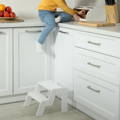
Toddler on a step stool in a kitchen.

Learning Tower vs Step Stool: What Each One Is Really Designed For

Before getting into safety, space, and daily use, let’s take a quick look at what each option actually is.

What Is a Learning Tower (Kitchen Helper)?

A learning tower, often called a Montessori kitchen helper, is an enclosed standing platform that lifts toddlers to counter height while helping keep them in one place. Instead of standing on something, your child stands inside the structure, surrounded by safety rails on all sides.


Most learning towers have an adjustable standing platform. This allows the tower to grow with your child, often from around 18 months through early childhood. They’re also built to be heavy and stable.


The main purpose of a learning tower is to let kids hang out at counter height without turning every moment into a balancing act. Toddlers can stand comfortably while washing vegetables, stirring, pouring, or just supervising your cooking like a tiny manager. And because the structure helps keep them in one spot, parents usually feel more comfortable using both hands.

Little girl in a learning tower.

Typical uses include meal preparation, bathroom sink access for teeth brushing or hand washing, and simple counter-level activities that support Montessori practical life kitchen skills.

Key things to know:

  • Requires dedicated floor space and isn’t easy to move.
  • Designed as a long-term piece used for several years.
  • Encourages independent climbing in and out.

Important safety note: Even with an enclosed design, adult supervision is essential. Toddlers can still reach countertop hazards, so kitchen safety toddlers depends on both the setup and an attentive adult.

What Is a Step Stool for Toddlers?

A step stool for toddlers is the simpler, more flexible option. It’s an open platform, sometimes one step, sometimes two, that helps a child reach sinks, counters, and shelves without being enclosed. Some designs include handrails, others don’t, but the goal is the same: quick up, quick down.

Step stools are lightweight and easy to move, which makes them useful all over the house. They’re built for short, everyday moments, not long stretches at counter height.

You’ll typically see step stools used for:

  • Hand washing and teeth brushing at the bathroom sink.
  • Brief counter tasks or quick “helping” moments.
  • Reaching shelves, switches, or dressers.
  • Potty training (getting on and off the toilet).

Because they’re compact, step stools store easily and come at a lower price point. Many families like that one stool can follow a toddler from room to room as their needs change.

Kid next to the step stool.

The trade-off is supervision. With an open design, a child can step off, lean, or climb down at any time, sometimes faster than you expect.

Important safety note: step stools require constant, hands-on supervision. They support independence, but they’re not designed for extended counter time where toddler kitchen safety is critical.

Learning Tower vs. Step Stool: Side-by-Side Comparison

Both options get toddlers up to counter height, but they do it in very different ways. Below, we’ll compare how a learning tower and a step stool stack up when it comes to safety, independence, daily use, space, age range, and real-life practicality.

Safety Considerations at Counter Height

When we talk about toddler kitchen safety, this is the section that matters most. A learning tower vs step stool choice changes the type of risk, not the need for supervision.


With a learning tower, the enclosed platform and four-sided rails help reduce sudden slips or missteps. It’s heavy and stable, so tipping isn’t much of a concern. That containment gives many parents more confidence during longer tasks.


The trade-off?


Kids can still reach countertop items, and some toddlers can climb out if they’re determined. Its weight also means you can’t quickly slide it away from a hot pan or sharp tool.


A step stool for toddlers is the opposite. It’s easy to move, easy to grab your child from, and easy to remove from a risky situation. But the open design means a child can step off without warning, lean too far forward, or tip the stool, especially during energetic moments.


Critical reminder: Neither option makes the kitchen “safe.” The American Academy of Pediatrics clearly states that young children should never be left unattended in the kitchen. No product replaces active, close supervision, ever.

Independence and Skill Building (Montessori Perspective)

Both options support independence, but in different ways, and for different lengths of time.

A learning tower is built for longer stretches of involvement. Toddlers can stand comfortably for 5-15 minutes or more, using both hands to pour, stir, wash, and “cook” alongside you. That steady setup encourages focus, patience, and the kind of deep engagement that turns helping into a real co-cooking experience.

A step stool for toddlers supports quicker wins. It’s perfect for routine tasks like hand washing or brushing teeth, and it teaches kids how to climb up and down safely on their own. Because it moves easily, it encourages independence across multiple rooms, not just the kitchen.

From a Montessori lens, both align with practical life principles. Therefore, children learn best by participating in real, everyday activities.
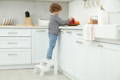
Kid standing on a step stool.

Practical Daily Use in Real Homes

This is where the decision gets very real, very fast. Ask yourself: how often will this be used, and for how long each time?

A learning tower shines in homes where cooking together is part of the daily routine. If your toddler helps every night and likes to stay involved for a while, the tower earns its keep. It usually lives in one spot (the kitchen) and becomes part of the flow of meal prep.

A step stool for toddlers is better for quick hits. Thirty seconds at the sink. A minute to help at the counter. Then it’s off to the bathroom or bedroom. It’s light, easy to move, and easy to store, perfect for small spaces and busy days.

Space and Storage Realities

Kitchen space is precious, especially once a toddler is underfoot. This is one area where the difference between the two options is impossible to ignore.

Feature

Learning Tower

Step Stool

Footprint

Requires dedicated floor space (about 1.5’ x 2’)

Very compact when in use

Placement

Permanent or semi-permanent kitchen fixture

Can move from room to room

Storage

Some models fold, but are still bulky

Stores under sink, in closet, or behind a door

Daily Impact

Becomes part of the kitchen layout

Easy to clear for cleaning or guests

If your kitchen is tight, a learning tower can feel like furniture you walk around. A step stool, on the other hand, disappears when you don’t need it.

Age Range and Long-Term Use

A learning tower is usually most useful from around 18 months through early childhood, often up to age six or beyond. The adjustable platform helps it grow with your child, and many kids keep using it well into their “I can cook” phase.

A step stool for toddlers technically never expires. Toddlers use it. Preschoolers use it. Adults end up borrowing it. The trade-off is that you may swap models as your child grows.

The big factor isn’t age, it’s interest. Both become far more valuable once toddlers truly want to help, which often ramps up between 18 and 24 months.

Kids sitting on a bar stool.

Budget and Value Considerations

A learning tower is a bigger upfront investment. Most fall in the $100–$300+ range. A step stool for toddlers is much easier on the wallet, usually landing between $20 and $80.

What matters more than the sticker price is the cost per use. A learning tower that gets used every day for three or four years can easily justify its price. A step stool that moves between rooms and gets used multiple times a day can do the same.

There’s no universal answer to “Is a learning tower worth it?” The right choice is the one that fits your space, routine, and budget, without adding stress or second-guessing to your day.

Where Learning Towers and Step Stools Are Similar

Despite their differences, learning towers and step stools share a lot of common ground.

Both help toddlers reach counter height with supervision, and both support Montessori ideas around independence and involvement. Neither removes the need for an adult nearby, and both work best when basic child-proofing is in place.

No matter which you choose, both:

  • Support practical life skill development.
  • Build balance, coordination, and body awareness.
  • Encourage participation in daily routines.
  • Foster connection during everyday moments.

From a Montessori point of view, the environment should adapt to the child. Sometimes that means an enclosed tower. Other times, a simple stool does the job.

Choosing What Fits Your Family

Here’s the honest truth: there’s no universal right answer. Only what works for your family, in your space, with your child. The best choice is the one you can use safely and consistently, without frustration.

Kid on the countertop.

Consider a Learning Tower If…

A learning tower tends to work well for families who cook at home most days and want their toddler involved for longer stretches. If you have enough kitchen space and your child likes to stand, watch, and help for 10 minutes or more, the enclosed design can feel reassuring.

Many parents also prefer the added containment when tasks require both hands, always while staying close and supervising. Learning towers often suit toddlers in the peak “I must help” phase, roughly 18 months to 4 years, especially kids who do better with clear boundaries.

Consider a Step Stool If…

A step stool for toddlers fits families who value flexibility. If your kitchen is small, your toddler is constantly on the move, or you need one tool that works in the bathroom, bedroom, and kitchen, a stool makes sense.

It’s ideal for quick tasks, hand washing, teeth brushing, hopping up to help briefly, then moving on. Step stools also appeal to parents who are comfortable with close, hands-on supervision and want something easy to store and useful long after the toddler years.

Why Not Both? A Complementary Approach

For many families, this isn’t an either-or decision. A common setup is a learning tower in the kitchen for cooking and longer activities, paired with a step stool in the bathroom or bedroom for quick, everyday tasks.

This approach can also be budget-friendly. Some parents start with a step stool to see how much their toddler actually wants to help, then add a learning tower later if kitchen involvement really takes off.

Real Family Scenarios

The Chen family uses a learning tower every evening during dinner prep. Their two-year-old washes vegetables and stirs while they cook, while a step stool lives in the bathroom for hand washing and teeth brushing.

Sarah’s small apartment kitchen couldn’t fit a learning tower, so her step stool moves from room to room as needed. She stays close during quick counter tasks.

After six months with the best step stool for toddlers, the Rodriguez family added a learning tower when their daughter’s kitchen interest took off.

Safety Reminders and Best Practices for Toddlers at Counter Height

No matter which option you use, the rules stay the same: counter height always means supervision. There are no shortcuts here, just smart habits.


Before your child steps up, clear the counter. Knives, hot pans, cleaning products, and heavy appliances should be out of reach. Think from your toddler’s new height, not yours. If they can reach the stove, add knob covers. If something could tip or fall, move it back.
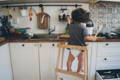
Kid in a learning tower in the kitchen.

Teach safe climbing up and down during calm moments, not when dinner is burning. Go slow. Show them how. Set simple rules like “ask first” before climbing.


Most importantly, never leave a child unattended at counter height. Both the American Academy of Pediatrics and Safe Kids Worldwide stress that active supervision is essential in kitchens.

Final Thoughts: Trusting What Works for Your Family

Both a learning tower and a step stool can support meaningful parent–child moments. What matters most isn’t the product. It’s a safe, supervised involvement in everyday life.

Some families need structure. Others need flexibility. Many use both. None of those choices is “more right” than the others, and budget or space doesn’t define good parenting.

Trust what fits your home, your routine, and your child. When toddlers feel included, stirring, watching, and helping, they’re learning far more than how to cook.

  • Free Delivery

    Over $80
  • Easy Returns

    No questions asked
  • Unbeatable Warranty

    1-year ++ warranty

  • Secure Checkout
    World’s most secure payment method